
But buying into that demand carries real risk. Counterfeit goods, vague "authorized" claims, restrictive sales terms, and channel limitations trip up buyers constantly. Some buyers also confuse a supplier's business or resale license with actual permission to use someone else's trademark or brand — those are two completely different things.
This guide walks through how to verify a licensed wholesale supplier, what a license actually covers, and how to build a smart, defensible product assortment.
Key Takeaways
- Licensed merchandise and wholesale are separate concepts: one is about IP permission, the other about B2B purchasing volume.
- Verify the supplier, authorization scope, labels, territory, channels, and terms before ordering — every time.
- A resale certificate or business license doesn't prove branded goods are officially licensed.
- Start small: order samples, get documentation in writing, and build a focused assortment for your actual customers.
Licensed Wholesale Merchandise: Definition, Value, and Licensing Basics
What does licensed wholesale merchandise mean?
Licensed merchandise uses another party's protected intellectual property (a trademark, character, team logo, artwork, or slogan) under a formal licensing agreement. Licensing International defines it as leasing rights from a licensor to a licensee for use on a product or service.
Wholesale is a separate concept entirely. It just means buying products in bulk for resale, rather than as a single consumer purchase.
Key players in this chain:
- Licensor – owns or represents the IP
- Licensee – manufacturer authorized to produce goods using that IP
- Wholesaler/distributor – sells licensed goods in bulk to retailers
- Retailer – sells the finished product to consumers
How licensed products differ from other merchandise
Not everything themed or fan-appealing is licensed. Four distinct categories exist:
- Licensed: authorized use of protected IP under agreement
- Generic/original: no third-party IP involved at all
- Fan-made: unauthorized use, often well-intentioned but still legally exposed
- Counterfeit: deliberately deceptive goods mimicking a registered mark
The U.S. Copyright Office is blunt about fan-made products: an unauthorized derivative can still support an infringement claim, and fair use has no fixed safe threshold. This matters for custom merchandise too. Even if a buyer supplies their own design, any third-party name, logo, or character woven into it still needs clearance.
Why licensing matters to wholesale buyers
Licensed goods tap into audiences that already care. Sports properties grew 8.5% to $44.4 billion in 2025, and entertainment and character licensing reached $161.8 billion, per Licensing International industry data. Online retail now accounts for 32% of global licensed sales.

For a wholesale buyer, that translates to:
- Built-in customer recognition (no education needed to sell a national team blanket to a soccer fan)
- Differentiation from generic private-label stock
- Seasonal and event-driven sales spikes (World Cup years, NFL season, holidays)
None of that removes your responsibility as a seller, though. Listings, packaging, and social posts still need to accurately reflect authorization status. Misleading "official" claims create legal exposure for you, not just the supplier.
What a license does and does not guarantee
A license is a scoped legal document, not a blanket permission slip. WIPO's licensing guidance notes that rights can be limited by territory, product category, term, and sales channel. A license can even be exclusive in one market and non-exclusive in another.
What this means practically:
- A supplier licensed for US retail may not be licensed for marketplace or export sales
- A license active today may expire or convert to non-exclusive next year
- Product category matters — a soccer jersey license doesn't automatically cover bedding
Always confirm current terms directly with the supplier rather than assuming last year's agreement still applies.

How to Verify a Licensed Wholesale Supplier
Request evidence of authorization
Ask for documentation tying the supplier to the licensor, licensee, or authorized distributor. Confidentiality clauses may limit what's shared, but a legitimate supplier should be able to confirm:
- Authorized product category (blankets vs. apparel vs. drinkware)
- Current license term
- Territory covered
- Whether they're permitted to sell to wholesalers at all
Confirm the rights cover your intended use
A license good for physical retail doesn't automatically extend to ecommerce or marketplace sales. Ask directly:
- Does this cover US wholesale distribution?
- Is marketplace or online resale included?
- Are there restrictions on sublicensing or export?
- Does the territory match where you'll actually sell?
Check that the business itself is traceable
Before you check licensing, check the business. The FTC recommends searching the company name alongside "scam" or "complaint" before paying anyone.
A basic legitimacy checklist:
- Verifiable business address and working phone number
- Written quotes and invoices (not just verbal promises)
- Clear payment terms and customer service policy
- Consistent product descriptions across catalog, invoice, and website
- Business registration and trade references you can independently confirm
Don't treat a single online review or directory listing as proof of anything. Cross-check multiple sources.
Inspect samples, labels, and packaging
Order samples before committing to volume. Check:
- Material quality, stitching, and printing consistency
- Color accuracy against catalog images
- Country-of-origin marking (required in English on imports per CBP guidance)
- Care labels and fiber content on textiles
- Whether licensor/licensee identification appears where expected
Label formats vary by brand and product, so don't assume a missing element automatically means a fake — but flag anything inconsistent for follow-up.
Review wholesale terms before ordering
Compare pricing, minimum order quantities, case pack sizes, lead times, and shipping responsibility across suppliers. Then calculate your actual landed cost: product price + freight + applicable duties + marketplace fees + fulfillment costs.
Skipping this step is how buyers end up with margin surprises after the invoice is already paid.
Keep a verification file
Save everything: quotes, invoices, authorization statements, sample photos, and correspondence about brand-use permissions. If documentation is incomplete or a supplier can't clearly explain their authorization chain, get written clarification before you list a single product.

Choosing Products and Planning a Wholesale Range
Match categories to customer and channel
Different product types serve different fan segments and price points:
- Blankets for gift buyers
- Apparel for everyday wear
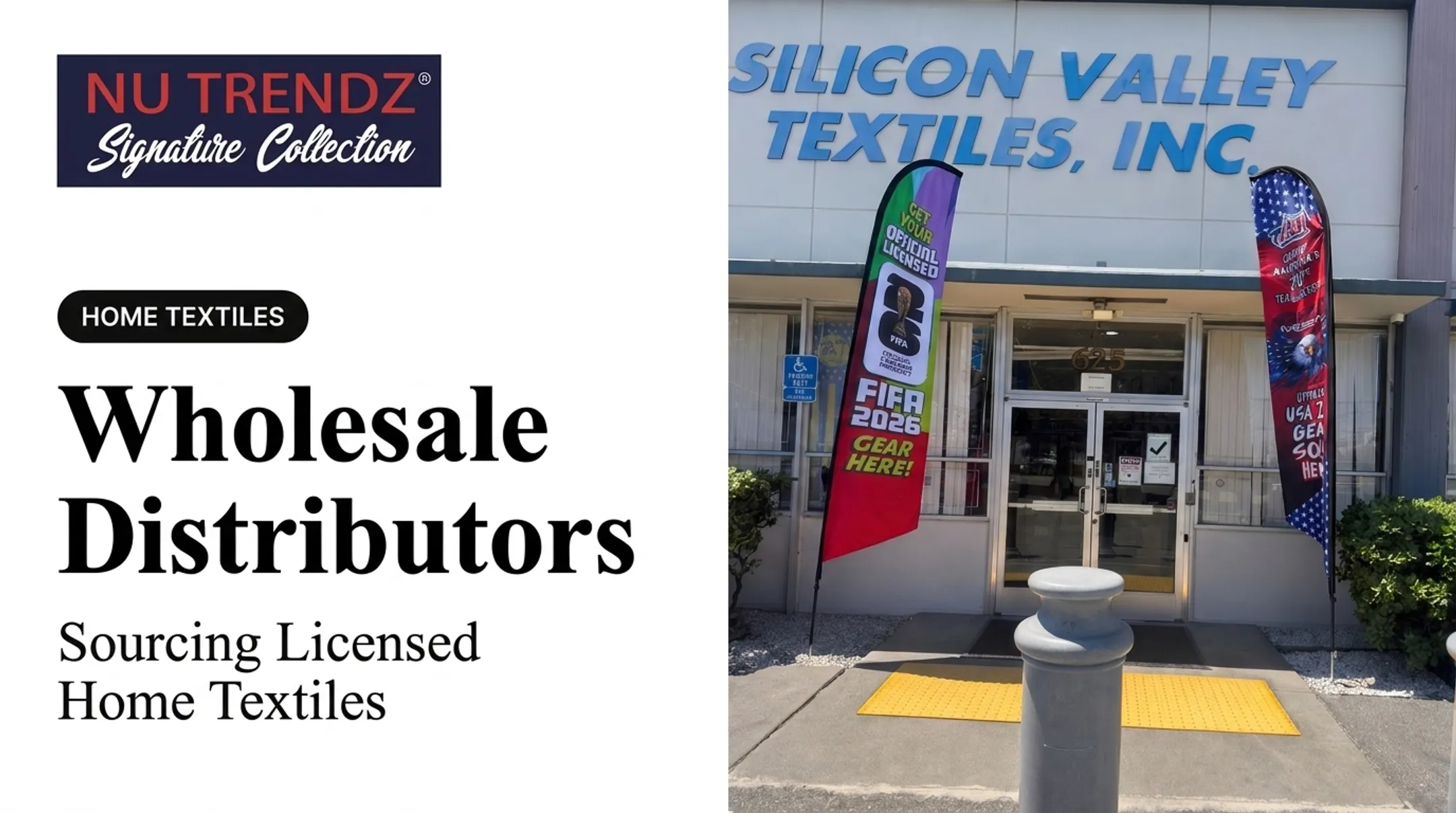
- Drinkware and accessories for impulse add-ons Silicon Valley Textiles, a San Jose-based textile supplier, carries a mix that includes:
- Artist-licensed signature blankets
- Soccer merchandise tied to FIFA 2026 and participating national teams
- NFL-licensed blankets
- Novelty lines such as Bigfoot/Sasquatch-themed apparel and blankets Confirm current availability and licensing documentation for the specific SKUs you're ordering.

Build a focused assortment
Resist the urge to stock everything at once. Instead:
- Pick one anchor product (a signature blanket line, for example)
- Add two or three complementary accessories
- Watch sell-through and seasonality before expanding
- Plan replenishment before you run out, not after Storage costs and dead stock erode margin fast. A tight assortment beats a sprawling one.
Separate licensed and custom lines clearly
Licensed collections, generic products, and custom-designed merchandise need distinct marketing treatment so customers aren't misled about what's officially authorized. Silicon Valley Textiles, for instance, also offers custom textile products: personalized blankets, towels, pillows, bags, and apparel. Any third-party logo or protected design added to a custom order still requires its own permission. "Custom" doesn't mean "exempt from IP rules."
Wholesale Purchasing and US Compliance
Confirm business and resale requirements
Depending on your state and business model, you may need a business license, sales-tax registration, resale certificate, or seller's permit. Requirements vary — Washington and Illinois each have their own reseller permit systems.
One state's certificate doesn't automatically work in another. Check with your state revenue agency directly.
Important distinction: these are tax and business documents. They say nothing about your right to use someone else's brand or artwork. That permission comes only from the licensor or an authorized licensee.
Use a structured quote-and-sample process
- Define your customer and channel before shopping suppliers
- Shortlist authorized suppliers based on documentation, not marketing claims
- Request a catalog, quote, and licensing/labeling information together
- Review samples for quality and label accuracy
- Confirm terms in writing — pricing, minimums, lead times, returns
- Place a controlled initial order before scaling up

Check product-specific obligations before selling
Textile products carry specific federal labeling rules. Under the FTC's Textile and Wool Act, labels must show:
- Fiber content
- Country of origin
- Manufacturer or responsible-party identification
Care labeling is a separate FTC requirement for clothing and certain piece goods. Apparel may also fall under CPSC flammability standards, depending on the product.
Avoid authenticity, safety, or "official" claims unless your supplier or the licensor can back them up in writing.
Next Steps for Building a Licensed Merchandise Assortment
Use this checklist to move from research to a sellable licensed assortment:
- Define your target customer and sales channel
- Select categories that match that customer
- Identify suppliers who can document their authorization
- Verify licensing scope matches your intended use
- Inspect samples before committing to volume
- Review wholesale terms and calculate real landed cost
- Keep every document on file
If you're a wholesale buyer exploring licensed sports, soccer, or themed textile merchandise, contact Silicon Valley Textiles at sales@siliconvalleytextiles.com for current product availability, licensing details, and a quote. Confirm specific minimums, brand availability, and authorization scope before ordering.
Frequently Asked Questions
How do I know if a wholesaler is legit?
Check for a traceable business address, working contact information, clear written invoices and terms, and independently verifiable references. Ask for samples and documentation proving authorization to sell the specific branded merchandise you want.
Do you have to have a license to be a wholesaler?
Business, tax, and resale requirements vary by state and product type, and you'll typically need at least a resale certificate or seller's permit. An IP license is separate: it is the brand owner's permission to use protected marks, not a tax or resale permit.
Can I buy wholesale without an LLC?
An LLC isn't universally required to purchase wholesale. However, individual suppliers, marketplaces, and state tax authorities may each require their own business or resale documentation, so check requirements case by case.
Where can I find wholesale licensed merchandise?
Start with brand owners, authorized licensees, and verified distributors that can document licensing rights. Silicon Valley Textiles supplies licensed sports and novelty goods to wholesale buyers. Request samples and written authorization before any large order.
What does "licensed merchandise" mean?
It's merchandise made or sold under permission to use another party's protected brand assets, such as a logo, character, team identity, or slogan. That permission comes from a formal licensing agreement, not just similarity in theme.
What is an example of a licensed brand?
FIFA states that products bearing its IP without a license are treated as counterfeits. Only authorized licensees may manufacture and sell official FIFA-branded goods.